

Registration is now closed for this research, findings will be shared in the future
About the researcher
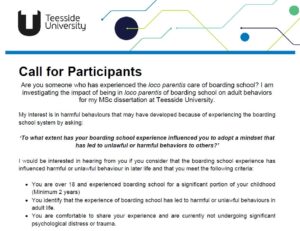
As a boarding school survivor who was sent to board from age 8 to 16 between 1979 and 1985 I have been on a healing journey for the last few years. I am currently studying for a master’s degree in criminology at Teesside University, and embarking on my dissertation and reaching out for potential introductions to boarding school survivors who may wish to participate in my research.
I am researching the traumatic impact of being placed into loco parentis care and the influence that this has on developing harmful behaviors or unlawful activity in later life. The current researched evidence lens focuses on those placed in the loco parentis care of the social care system which has impactful symptoms of abandonment, rejection, self-reliance, and anger which leads to half of those leaving the social care system engaging in harmful and illicit activities leading to involvement with the criminal justice system.
Psychologist Nick Duffell (2000:2016) posits that being placed into the loco parentis of boarding school is effectively being placed in to care and that the psychological impacts are common. With the further identification of Boarding School Syndrome by psychologist Joy Schaverien (2004; 2011; 2015), I seek to explore the similarities between the impact of both these ‘habitus’ (Bourdieu, 2017) and how the experience of boarding school can and may lead to a sense of ‘special liberty’ (Hall and Winlow, 2015), or entitlement (Duffell, 2016) where subjects inflict harm in order to achieve, or simply survive post care system.
The objective of my research is to search for universal truths in these two parallel streams of entities of care systems, and to shift the lens from focusing on the low hanging fruit of working-class illicit activity and towards that of the un-examined deviant and illicit activities of the socioeconomic elite and ‘privileged’ classes.
I have embarked on recognising the psychological impacts of this period in my life and been on a healing journey. During that journey I have reflected on difficult times when I have often not acted or behaved appropriately and wondered where this originates. Although I cannot attribute this to my boarding experience , its all I know so there must be some truths to be explored.
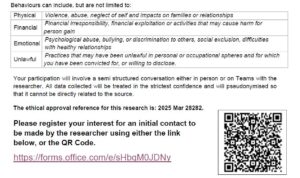
As part of course of study in criminology I have been fascinated by the move of studying beyond the constructs of crime and into harmful behaviours which would not necessarily be classed as crime, yet are themselves impactful on others. This area of criminology is called zemiology which originates from the Greek word ‘Zemia’ meaning harm or detriment. This takes me on a psychosocial path of interest into the way that ex boarders may have what Psychoanalyst and historian Nick Duffell named an ‘entitled’ brain which may have some influence on harmful behaviours from being placed into the care of boarding school . Recent criminological theory of Ultra Realism developed by Steve Hall and Simon Winlow in their studies of deprived communities identifies a similar subjective motivator to harm others which they named ‘special liberty’ where subjects willingly inflict harm to achieve, or simply survive in our symbolic world and system.
This has led me to question that perhaps the two have some universal application to behaviours that were socially learned or developed in the environment of boarding school and the negative emotions that this experience brings. I underpin my research question on the empirical knowledge that 50% of state care leavers invariably go on to engage with the criminal justice system in later life, which has connections with being placed into state loco parentis care as a child. If this is the case, what is the impact of being placed in ‘privileged’ loco parentis care of the institution of boarding school? And how do harmful behaviours play out for those that possess more social capital because of their loco parentis schooling?


